Article
Jan 21, 2026
How AI is Transforming Workflow Automation for Businesses
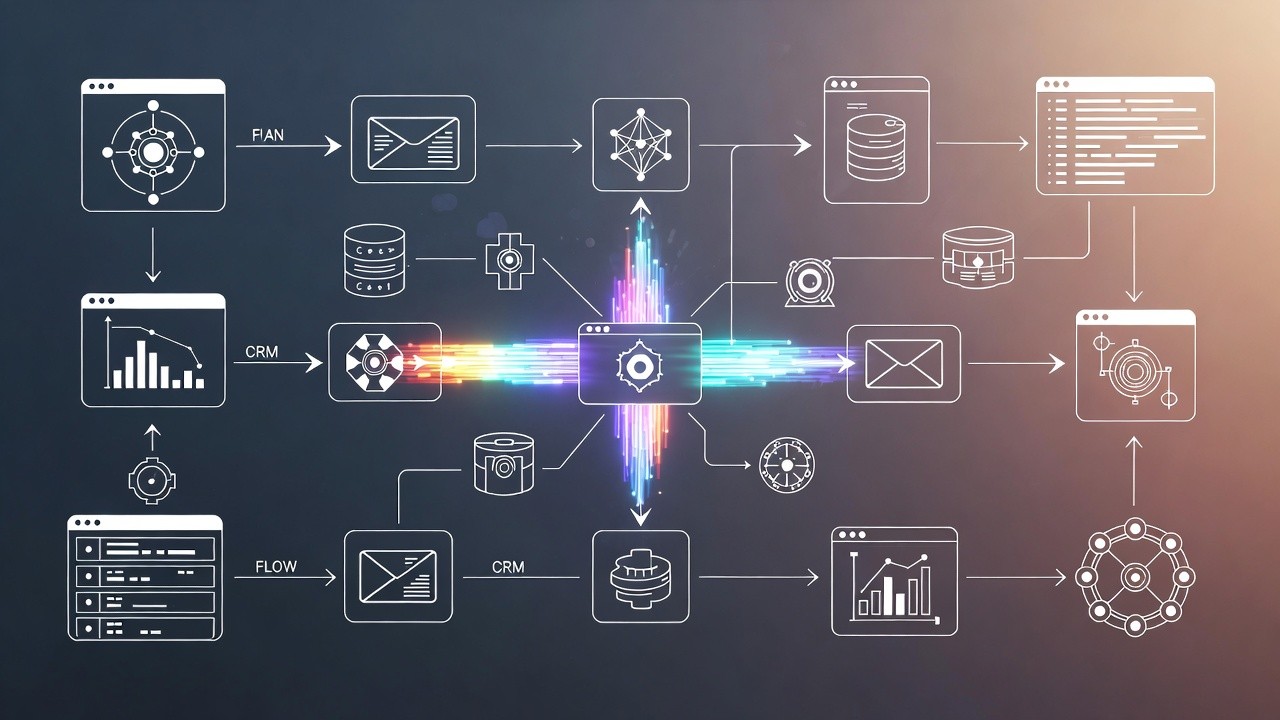
AI is transforming workflow automation by replacing manual processes with intelligent systems that work faster and more accurately. Businesses can automate repetitive tasks, reduce delays, and improve collaboration across teams. This shift helps organizations save time, cut costs, and scale operations more efficiently while maintaining consistency and control.
Introduction
AI is no longer a “future technology” it’s a driving force behind today’s business transformation. Companies in every industry are using AI to streamline their workflows, automate time-consuming tasks, and make better decisions. What once required a team of employees can now be completed instantly with AI-driven systems.
From marketing and sales to finance, logistics, HR, and customer support, AI is enhancing productivity and reshaping how work gets done. Here’s a deeper look at how AI is transforming workflow automation and what it means for businesses moving forward.
Enhancing Productivity with AI
AI-Powered Automation
One of the most significant benefits of AI is its ability to automate repetitive, manual tasks that slow teams down. These tasks include:
Data entry and data cleanup
Email sending and follow-ups
Customer support responses
Lead qualification
Appointment scheduling
Document processing
Workflow routing and approvals
By handling routine tasks automatically, AI frees employees to focus on creative, strategic, and revenue-generating work resulting in higher productivity and better job satisfaction.
In short: AI removes bottlenecks so teams can operate at their full potential.
Smarter Decision-Making
Today's businesses generate more data than ever before, but without the right tools, that data becomes noise. AI solves this by analyzing thousands of data points instantly and extracting valuable insights. AI-powered analytics can:
Identify trends and patterns
Predict customer behavior
Assess risks in real time
Optimize business operations
Improve forecasting accuracy
Instead of making decisions based on assumptions, leaders can rely on data-backed insights that drive measurable results.
With AI, decision-making becomes faster, smarter, and significantly more accurate.
AI’s Impact on the Workforce
New Opportunities for Employees
AI is not simply replacing jobs it’s changing the nature of work. When repetitive tasks are automated, employees can shift their attention to activities that require:
Strategic thinking
Creativity
Relationship-building
Problem-solving
Innovation
This leads to higher employee engagement and the creation of new job roles such as:
AI workflow managers
Automation specialists
Data analysts
AI operations coordinators
Rather than eliminating jobs, AI transitions employees into more meaningful, high-impact roles.
The Need for Reskilling
As AI becomes more integrated into daily operations, the demand for new skills rises. Businesses must help their teams adapt through:
Upskilling programs
Digital literacy training
AI tool onboarding
Technical workshops
Continuous learning initiatives
Workers who understand automation tools and AI systems will thrive in the evolving digital economy.
Companies that invest in reskilling build stronger, more future-ready teams.
AI and Business Growth
Scaling Operations Effortlessly
Traditional scaling often requires hiring more staff, expanding facilities, or increasing overhead costs. With AI, growth can happen exponentially without the same financial burden. AI-powered systems can:
Handle high workloads instantly
Manage customer interactions at scale
Streamline supply chains
Automate entire workflows end-to-end
Maintain accuracy even during high-volume operations
This allows businesses to stay lean, efficient, and highly responsive even during rapid expansion.
Competitive Advantage
Companies that implement AI early gain a powerful advantage over competitors still relying on manual workflows. AI helps organizations:
Optimize marketing and sales performance
Personalize customer experiences at scale
Improve business forecasting
Reduce operational costs
Increase output without increasing staff
Deliver faster, more reliable service
In a world where speed and accuracy matter, AI gives businesses the edge they need to lead their industry not follow.
Conclusion
AI is revolutionizing business workflows by increasing efficiency, enabling smarter decision-making, and creating new opportunities for employees. While adopting AI requires an initial investment and mindset shift, the long-term benefits far outweigh the costs.
Companies that integrate AI into their operations today will be the ones that thrive in the digital future. Workflow automation isn’t just a technological upgrade it’s the foundation of the modern, intelligent workplace.
The future of work is here.
And AI is powering it.